
Command always knows where every volunteer is. Even when the cell towers don't.
CertMesh gives your CERT team live locations, chat and ICS forms between the field and incident command. It uses cell service when it's there and switches to its own radio network when it isn't, with nothing for volunteers to configure.
After a disaster, command loses sight of its volunteers right when it matters most.
Towers go down
Hurricanes and tornadoes take out cell and internet service. Phones become cameras and flashlights.
Radios fall short
Most volunteers aren't licensed ham operators, and short-range handhelds don't reach across a damaged neighborhood.
Check-ins get missed
Command waits on scheduled location calls. Between them, nobody knows exactly where a team is or if they're okay.
Three steps. No training day required.
Check in with one scan
Command shows a QR code at the staging area. Volunteers scan it with the CertMesh app and they're on the incident. Their details fill in automatically next time.
Go to work. It finds a way through.
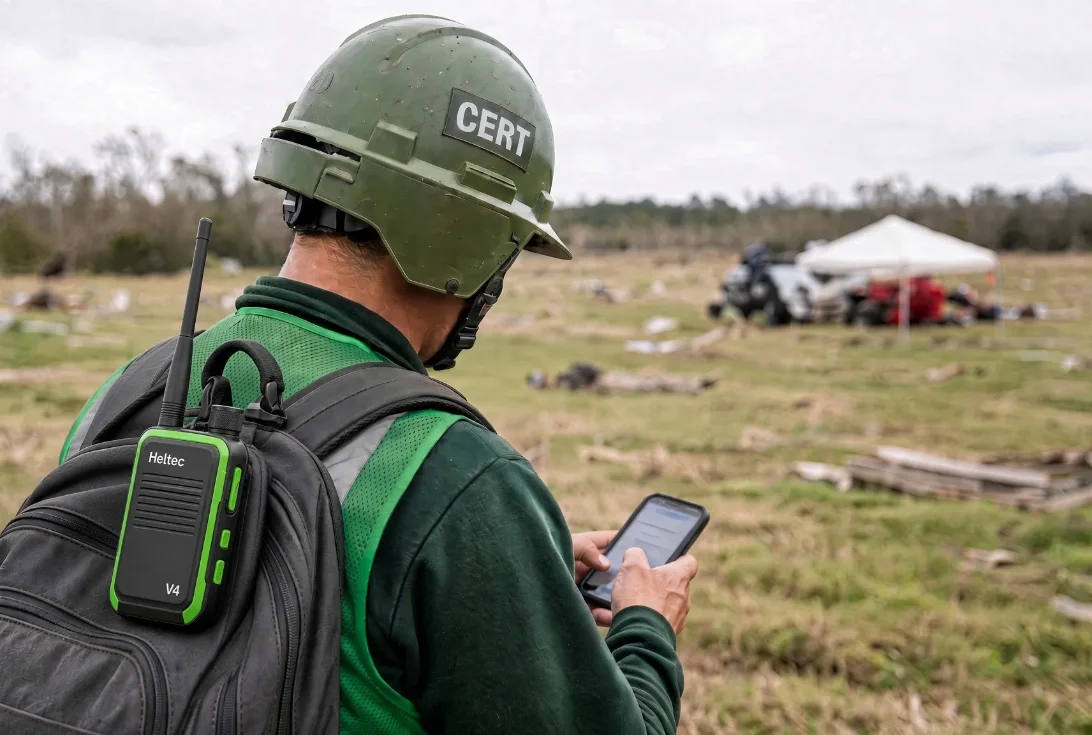
Messages travel over cell service when it's available. When it isn't, they hop between small pocket radios carried by the team, which reach for miles. Nobody has to choose or switch.
Command sees everyone
Every team member appears on one live map with their last position and status. Reports, requests and calls for help arrive in one inbox.
Every message gets where it's going.
Whatever happens to the network, CertMesh keeps track of what's been sent, what's still on its way and what has arrived. Your team can count on the record being complete.
A common operating picture that works on a folding table.
As simple as texting. Built for gloves and sunlight.
Volunteers send short messages the way they already do. Mark a downed line or a blocked road on the map with one button. Big touch targets and a high-contrast screen stay readable outdoors in direct sun.
The forms you already use, filled as the day goes.
Field teams file structured reports like damage assessments right from their phones. At command, your scribe turns incoming messages into ICS forms with a few taps, the same way they'd turn radio traffic into paper. A person always reviews before anything is filed.
See your volunteers' picture from the EOC.
When the command post has any internet link, such as satellite or a hotspot, CertMesh passes reports and requests up to your EOC. Requests for supplies can travel back down to the team that needs them.
Built up from the volunteer, not down from the enterprise.
Large emergency management platforms are made for county IT departments. CERT teams need something that works on day one, with leadership that changes every year.
Priced for volunteer budgets. Published for everyone.
One flat price per team, so your grant money can still go to radios and gear. No sales call, no per-seat math.
Need a budget line for a grant application? We'll send you a written quote.
- Unlimited volunteers and incidents
- Field app for iPhone and Android
- Command console, live map and forms
- Offline maps for your area
- Extra storage free for 90 days during a declared disaster
Common questions
Do our volunteers need a radio license?
No. CertMesh uses license-free radios, so anyone on your roster can carry one.
What equipment do we need?
Volunteers use their own phones. For no-service coverage, each person pairs a small off-the-shelf mesh radio with the app. We'll point you to models that work; you can buy them anywhere.
Do we need an IT person to set it up?
No. We host it for you. Your coordinator adds the roster, and volunteers join an incident by scanning a QR code. Agencies that must keep data in-house can run their own copy instead.
How far does the radio network reach?
Each radio passes messages along to the next, so range grows with your team. Messages can travel miles across several hops. A radio mounted on a parked vehicle makes a strong relay point.
Are messages kept on record?
Yes. Like radio logs and paper forms, messages and reports are logged and may be part of the public record. The app reminds volunteers of this when they write.
Can we use grant funds to pay for it?
Many CERT teams fund equipment and capability through state and federal programs. Check with your program manager; we're glad to provide a quote and a plain-language description for your application.
Be ready before the next storm, not during it.
Set up your team this week and run it at your next drill.